Compare triathlon formats and learn what to check beyond the distance before choosing an event.
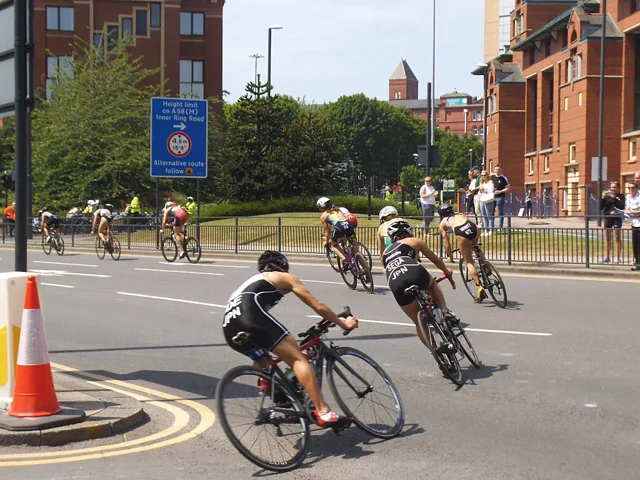
A sprint triathlon combines a 750 m swim, a 20 km bike and a 5 km run: about 0.47, 12.4 and 3.1 miles. Olympic distance doubles those segments to 1.5 km, 40 km and 10 km, or about 0.93, 24.9 and 6.2 miles. Super sprint is shorter, while half and full distance extend the time spent across all three sports.
The usual order is swim, bike, run. Sprint and Olympic distance provide useful reference points because the second doubles every segment of the first. That does not mean an athlete can simply double a sprint finishing time to predict an Olympic result. Riding and running for longer changes how the effort needs to be managed.
| Format | Swim | Bike | Run |
|---|---|---|---|
| Super sprint, Triathlon Canada reference | 250–500 m / 0.16–0.31 mi | 6.5–13 km / 4–8.1 mi | 1.7–3.5 km / 1.1–2.2 mi |
| Sprint | 750 m / 0.47 mi | 20 km / 12.4 mi | 5 km / 3.1 mi |
| Olympic or standard | 1.5 km / 0.93 mi | 40 km / 24.9 mi | 10 km / 6.2 mi |
| Half distance | 1.9 km / 1.2 mi | 90 km / 56 mi | 21.1 km / 13.1 mi |
| Full distance | About 3.8 km / 2.4 mi | About 180 km / 112 mi | About 42.2 km / 26.2 mi |
Super-sprint ranges allow different race layouts rather than defining one compulsory combination. Available space, lap arrangements and the competition structure help explain the difference. Metric and imperial figures are rounded for comparison; they are not separate measurements of a particular course.
It is shorter, but easy depends on your skills and the setting. Swimming 400 m, about 0.25 miles, in the sea involves different orientation and water movement from swimming the same distance in a pool. A short bicycle course with repeated tight turns also asks for more than fitness.
Consider a swimmer travelling at 2 minutes per 100 m, approximately 109 yards. A 400 m swim, about 0.25 miles, would take 8 minutes at that unchanged pace, while 750 m, about 0.47 miles, would take 15 minutes. These are arithmetic examples, not average amateur results or outdoor predictions.
Shorter racing can introduce the sequence without making the first outing a long-distance project. It still helps to become familiar with leaving the water, handling the bike and changing equipment. Those are practical tasks that separate swim-bike-run sessions do not always include.
Yes. Both identify 1.5 km of swimming, 40 km of cycling and 10 km of running. The total is 51.5 km, about 32 miles. The name describes distances rather than guaranteeing that every local race uses the same competitive arrangements as an Olympic broadcast.
Here is a worked example. Swimming at 2 minutes per 100 m takes 30 minutes for the swim. Riding at 30 km/h, about 18.6 mph, takes 1 hour 20 minutes for the bike. Running at 6 minutes per kilometre, about 9:39 per mile, takes 1 hour. Together that is 2 hours 50 minutes before transitions.
Those are selected speeds to make the calculation understandable. They are not a target, a qualifying requirement or a claim about the typical beginner. Changing the course or any one segment changes the total.
No. Half distance commonly means the 1.9 km, 90 km and 21.1 km combination shown above. Its imperial segments add up to approximately 70.3 miles. Full distance uses roughly 3.8 km, 180 km and 42.2 km, totalling about 226 km or 140.6 miles.
Long distance is a wider description. World Triathlon describes a typical championship configuration of 3 km swimming, 120 km cycling and 30 km running, or approximately 1.9, 74.6 and 18.6 miles. A long-distance event therefore need not use full-distance proportions.
This matters when comparing demands. A 30 km run is not the same task as a marathon after cycling. Likewise, a 3 km swim is shorter than 3.8 km. Looking at each segment is more informative than putting every long race in one category.
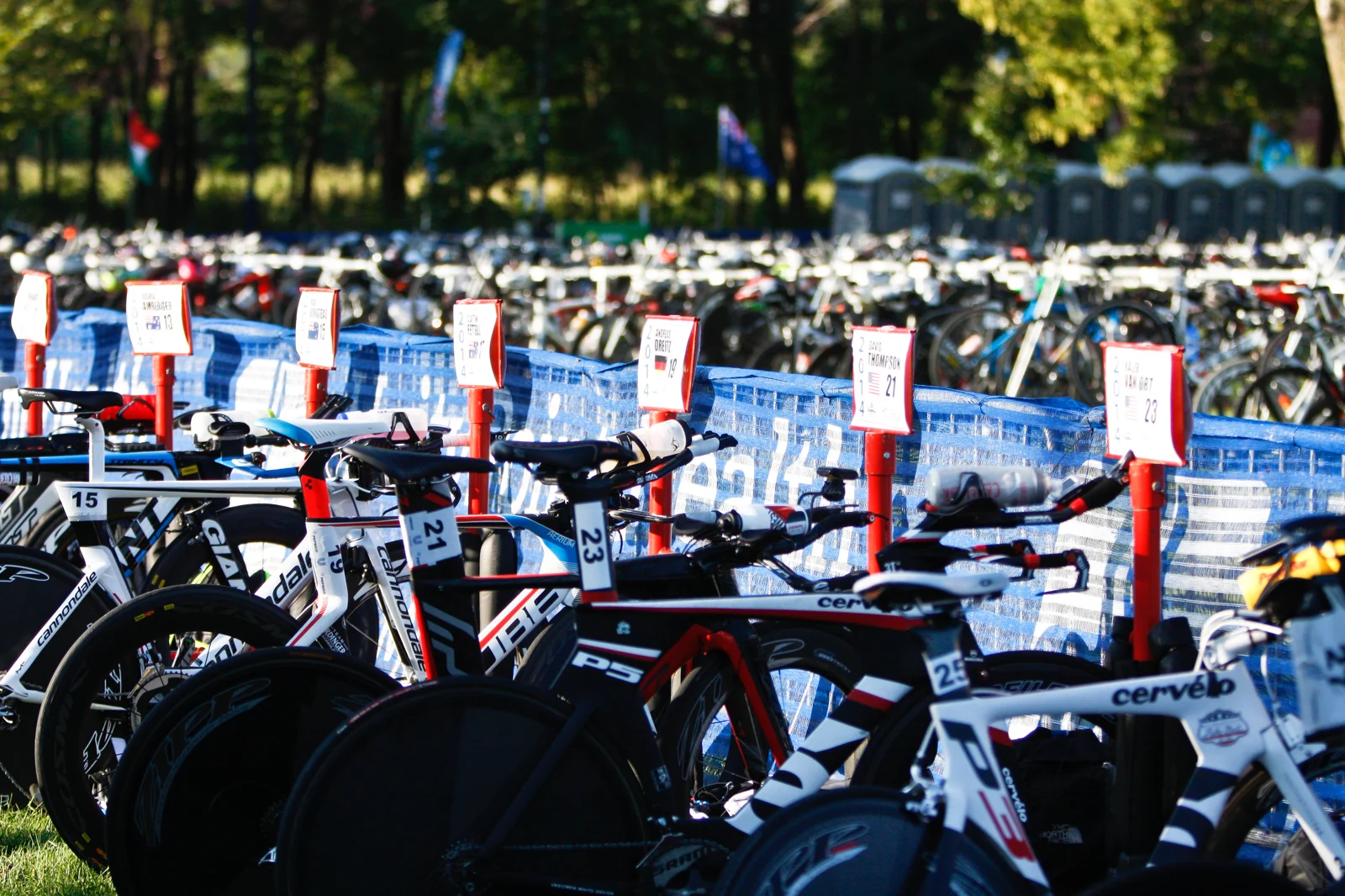
No. T1 connects swimming with cycling, and T2 connects cycling with running. Both contribute to overall race time. Add 3 minutes for each transition to the 2-hour-50-minute example and the finishing time becomes 2 hours 56 minutes.
Transitions involve finding your position, organising belongings and moving through the area. An athlete can lose time looking for a shoe without being physically exhausted. A simple arrangement makes the sequence easier to understand and practise.
You do not need to reproduce an entire race to learn that sequence. Becoming familiar with where equipment goes and practising the changes in a suitable setting helps remove confusion. Establishing a reliable order is more useful initially than rushing through unfamiliar tasks.
Water conditions, terrain and surface change the experience. A 20 km bike course, about 12.4 miles, could be one loop or four 5 km loops of about 3.1 miles each. The distance is identical, but the second layout repeats corners and passing points more often.
Drafting means riding in the shelter created by another cyclist. Some competitions allow that style of racing; others restrict it. Before participating, check the organiser's and governing federation's rules, such as World Triathlon's, once for the relevant drafting, equipment and transition requirements.
The landscape matters too. A flat run and a hilly run with the same measured length do not offer the same task. Comparing distances first is useful, but it should not hide the features you will actually meet.
Start with your least familiar sport. Regular running does not automatically prepare you for an outdoor swim. A clear swimming environment and appropriate support may matter more than choosing a race whose running distance already feels comfortable.
Then consider daily life. Three sports mean allocating sessions, travel and recovery across the week. An event close to home can simplify travel and make the setting easier to get to know. Compare the race with your own experience rather than another athlete's finishing time.
There is no compulsory ladder from super sprint to full distance. Many athletes enjoy staying with shorter racing. Use the separate sprint, Olympic and long-distance guides to explore the option that interests you, instead of treating the longest race as everyone's final destination.
 Everyone at their own pace. Together along the way.