Understand open-water swimming environments, event formats and the differences from swimming in a pool.
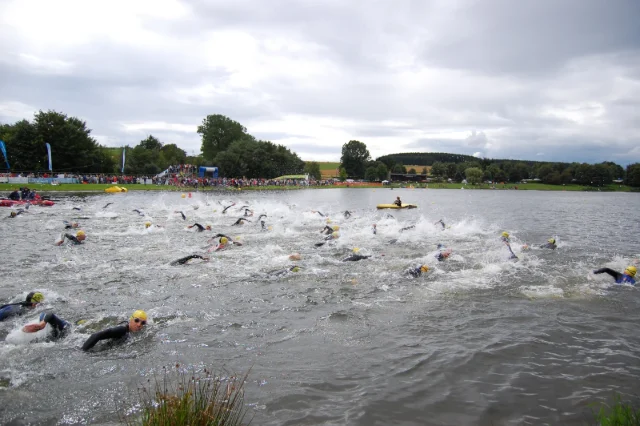
Open-water swimming means swimming in the sea, lakes or rivers rather than within pool lanes. The Olympic race covers 10 km, about 6.2 miles, and joined the Games at Beijing 2008. The wider activity also includes shorter routes, supported sessions and crossings, with navigation and water conditions shaping the experience.
In a pool, you reach a wall, turn and follow a familiar line. Outdoors, you use course buoys, the shore or other route references to work out your direction. The water can move, visibility can change and there is no wall at the end of every length.
A sea swim is not the same setting as a lake swim. Waves and currents can affect a coastal route. A lake that looks still can still have wind, changing temperatures or awkward exits. In a river, the direction of the current changes the relationship between effort and progress along the course.
| Setting | A practical difference |
|---|---|
| Sea | A wave may briefly hide the next course buoy |
| Lake | Wind can change the surface during a session |
| River | Current can help one direction and hinder the other |
| Pool | The wall provides a reference at every length |
Swimming ability remains important, but it now sits alongside navigation and understanding the setting. Completing a distance in a pool does not describe every task involved in covering it outdoors.
Open water is the broad description. A crossing often means travelling between points, although event names do not always describe the course literally. Marathon swimming is the familiar name for the Olympic 10 km race, about 6.2 miles. It does not mean swimming running's marathon distance of 42.195 km, or 26 miles 385 yards.
A route might connect two beaches, cross from one shore to another or circle buoys. Knowing whether the finish is beside the start helps with ordinary practical arrangements, such as where belongings go and how swimmers return after finishing.
The English Channel is a historic crossing, while an Olympic event belongs to a different competitive setting. Both are part of open-water swimming without sharing every equipment rule, distance or objective. Individual crossing guides can explain those traditions without turning each one into a version of the same race.
The Olympic 10 km, about 6.2 miles, is a high-level reference rather than a required starting point. Shorter route lengths can include 1 km, 1.5 km or 3 km, approximately 0.62, 0.93 or 1.9 miles. These are examples of distance, not a promise that any given event offers each option.
For a swimmer familiar with a 25 m pool, about 27.3 yards, 1 km means 40 lengths; 1.5 km means 60; and 3 km means 120. This compares length only. It does not reproduce the effect of turns, waves or choosing a line between buoys.
Formats can divide the work as well. At the 2025 World Championships, World Aquatics introduced a senior championship knockout event comprising 1.5 km, then 1 km and a 500 m final: about 0.93, 0.62 and 0.31 miles. Finalists cover 3 km in total, approximately 1.9 miles, but not as one continuous swim.
Buoys provide direction and turning references, while the course layout determines laps. Imagine a 500 m circuit, roughly 0.31 miles: two laps make 1 km, about 0.62 miles, and three make 1.5 km, about 0.93 miles. A course drawing turns the advertised distance into a sequence a swimmer can understand.
Starts may bring a group together or distribute swimmers across different times. Finishing can involve leaving the water or reaching a touch structure. Those arrangements change the last task and how spectators follow results, even when the distance stays the same.
Before racing, check the organiser's and governing federation's instructions, such as World Aquatics', once for the relevant course, start, finish and equipment requirements. Identifying entry, exit and support staff on site helps establish the setting before the swim begins.
It provides a reference, not a complete forecast. At 2 minutes per 100 m, about 109 yards, 1 km or 0.62 miles would take 20 minutes if the pace stayed unchanged. At 2:30 per 100 m, it would take 25 minutes. These are calculated examples rather than average amateur performances.
The distance actually swum may exceed the ideal course line. Covering 1.1 km instead of 1 km, about 0.68 rather than 0.62 miles, would turn 20 minutes into 22 minutes at the same pace. That simple example shows how navigation can enter the result without any change in swimming speed.
A helpful current can also shorten a time without indicating better fitness. Record the route, setting and water movement when comparing sessions. Looking only at the pace displayed by a watch can suggest improvement or decline that the surrounding conditions explain more clearly.
Goggles help you see while swimming, with light conditions and fit affecting the choice. A wetsuit influences thermal protection and buoyancy. A personal signalling float used during a session has another purpose and should not be confused with the large buoys marking a race course.
These items are not required or permitted identically in every setting. Water temperature and competition rules matter for wetsuit use. Information written for a triathlon does not automatically apply to a swimming crossing, because the sporting context can differ.
Equipment alone does not create a support system. A visible float cannot assess a current, organise an exit or replace supervision. Understanding each item's role is more useful than expecting an accessory to provide every kind of protection or to make an unfamiliar route appropriate.
Look for a supported activity led by someone experienced in that particular setting. Explain your pool background and familiarity with the sea, lakes or rivers. Swimming capacity and knowledge of the environment are related but separate questions, and both belong in that first conversation.
Before entering, understand how to communicate with support, where the exit is and how to stop the activity. Consider arrangements on shore too: access to the water, belongings and the return to the starting point. These ordinary details help turn an attractive photograph into a comprehensible activity.
Separate guides can explore navigation, different environments and historic crossings. For a first experience, understanding a shorter supported session is more useful than treating the Olympic 10 km, about 6.2 miles, as an immediate personal requirement.
 Everyone at their own pace. Together along the way.