How to choose your first triathlon beyond the distance
Compare the swim environment, course, travel and budget before deciding where your first start line will be.
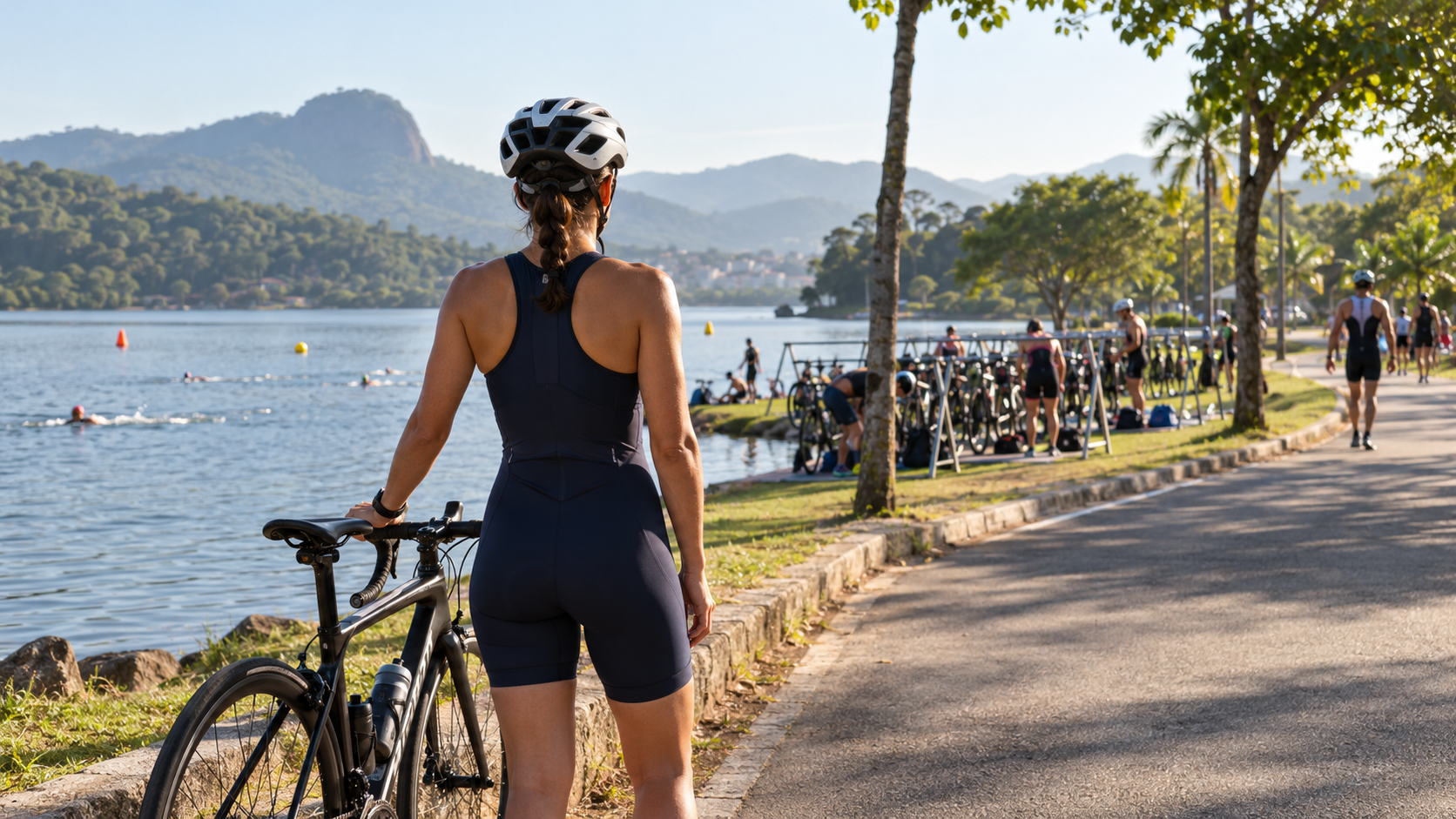
A race close to home, with a course you can understand and clear guidance, may be a more workable choice than the event that shows up in every video. Distance matters, but it does not explain the experience on its own. Sea, lake, traffic, cut-off times and logistics change a lot about what you will need to prepare.
Before paying the entry fee, turn the wish to take part into a few concrete questions. This guide is meant for comparing options with your coach or exercise professional. It does not decide whether you are medically fit, nor does it set how long you need to train.
Start with the swim environment
Check where the swim takes place and how athletes enter the water. A beach start is not the same as entering from a ramp. Find out whether the organizers publish a map, safety procedures and information about authorized course familiarization. Also ask how withdrawing and being taken out of the water work.
Being able to swim a distance in the pool does not, by itself, tell you whether you are ready for that environment. Visibility, sighting and swimming close to other participants deserve specific practice. If you have not yet had supervised open-water experience, make that part of the decision instead of leaving your first time in that environment for race day.
Read the bike leg as a course
Look for the number of laps, elevation, corners and road features. Confirm which type of bike is allowed and the drafting rules. Do not assume that a race called a sprint will run exactly like another one with the same name.
For someone who only rides on flat bike paths, a circuit with descents and corners may demand skills that have had little practice. For someone who already handles the bike well, the main difficulty may be getting it to the venue. List what depends on technical preparation and what depends on logistics; the solutions are different.
Find out about commitments outside the start
Some races spread activities over more than one day. The World Triathlon FAQ documentation shows that check-in, inspections and transition access have their own procedures. For your edition, look for the current schedule and confirm when you need to be there in person.
Put everything on your real calendar: travel, packet pickup, race briefing, bike check-in and getting back to work. If you can only arrive on Saturday night, an obligation on Saturday afternoon may rule the race out. Do not buy tickets counting on an exception.
Do the full math
Besides the entry fee, estimate transport, lodging, food, maintenance and any fees announced by the organizer. Add the cost of bringing the bike and the possibility of needing help to reassemble it. It does not have to be a sophisticated spreadsheet: a list of confirmed amounts and items still open already shows where the questions are.
Also consider the cost in family time. Will whoever comes along have somewhere to wait? Is there access to the venue? Does the schedule allow some shared activity? Treating these details as part of the choice helps the race fit into life instead of becoming a surprise for everyone in race week.
Compare using your own criteria
Create a sheet for each candidate race: swim environment, bike course, run distance, travel, in-person commitments, budget and open questions. Mark each item as comfortable, needs preparation or still unknown. Do not give a favorable mark to anything you could not verify.
Show the sheet to the professional who supports your preparation. A short race may not be the simplest option if the environment or logistics are unsuitable. Your initial goal may be learning to take part safely, finishing without rushing or getting to know the format; make that explicit before discussing finishing time.
Only then confirm your entry
Open the official page for that edition and check the date, category, minimum age, cut-offs and change policy. Ask the organizers your questions directly through the published channels. Keep your receipts and plan a new check close to the event, because courses and times can change.
Choosing well does not mean getting rid of all nerves. It means knowing where you are putting yourself and having a plausible path of preparation. The best first start line is the one that matches your current skills, the guidance you receive and the room that sport has in your routine.
References
- Triathlon FAQs — World Triathlon · open (accessed on 2026-10-15)
 Cada um no seu ritmo. Juntos no caminho.